
Why you bloat, and what's actually going on
Why are you bloated after eating, and what actually helps? Most post-meal bloat comes down to one thing: gas produced when food ferments in your gut faster than it can move through. Here is what is going on, and the levers that genuinely make a difference.
Grounded in 3 peer-reviewed studiesThe quick version
Key takeaways
- Bloat is gas from food fermenting before it is fully digested.
- Eating fast and eating big are the most common accelerants.
- Slowing down and chewing is the highest-leverage free fix.
- Enzymes help by breaking the meal down before it can ferment.
01Why do you bloat after eating?
Food leaves your stomach partly broken down. Your small intestine is supposed to finish the job and absorb the results. Anything that is not broken down in time travels on to the colon, where trillions of bacteria treat it as dinner.
That fermentation produces gas. Gas stretches the gut wall. You feel it as that tight, balloon-like fullness. 1 Occasional bloat is completely normal. Bloat after most meals is a signal that digestion is falling behind.
It helps to separate two things people lump together. Gas bloating is the pressurized, stretched feeling that builds through a meal and eases once things move along. Water retention is a heavier, all-over puffiness tied to salt, hormones, and hydration. They feel similar but have different causes, and how your body produces and clears gas is a big part of the bloating story. 3
02Common bloating triggers
A few usual suspects speed the whole process up:
- Eating quickly, which means bigger food particles and more swallowed air
- Large or very fatty meals that overwhelm your enzymes
- Carbonated drinks, which add gas directly
- Certain carbs, like beans, onions, wheat, and some fruit, that ferment readily (often called FODMAPs) 2
- The foods on that list are not villains. Beans, onions, and wheat are exactly the fibrous, plant-rich foods that feed a healthy microbiome. The goal is not to cut them out, it is to notice which ones repeat on you and give your digestion the help to keep up.
dissolves on your tongue
must survive the stomach
the default option
Approximate time before a digestive aid is active. A strip dissolves on contact; a capsule has to survive and open in the stomach first.
03How to reduce bloating
Most of what works is unglamorous and free:
- Slow down and chew thoroughly. It is the cheapest digestive aid that exists.
- Eat smaller, earlier meals when you can.
- Notice patterns. Bloat that repeats after the same food is information.
- Give your body enzymes to break the meal down before it reaches the fermenters.
04When bloating needs a doctor
Occasional bloat is routine. But bloating that is persistent, painful, or steadily getting worse, or that comes with weight loss or changes in your stool, belongs in a doctor's office, not a supplement routine. Rule out the serious stuff first.
05Where enzymes come in
If more of your meal is dismantled before it reaches the colon, there is less left over to ferment, and less gas. That is the entire idea behind taking digestive enzymes with or right after a meal.
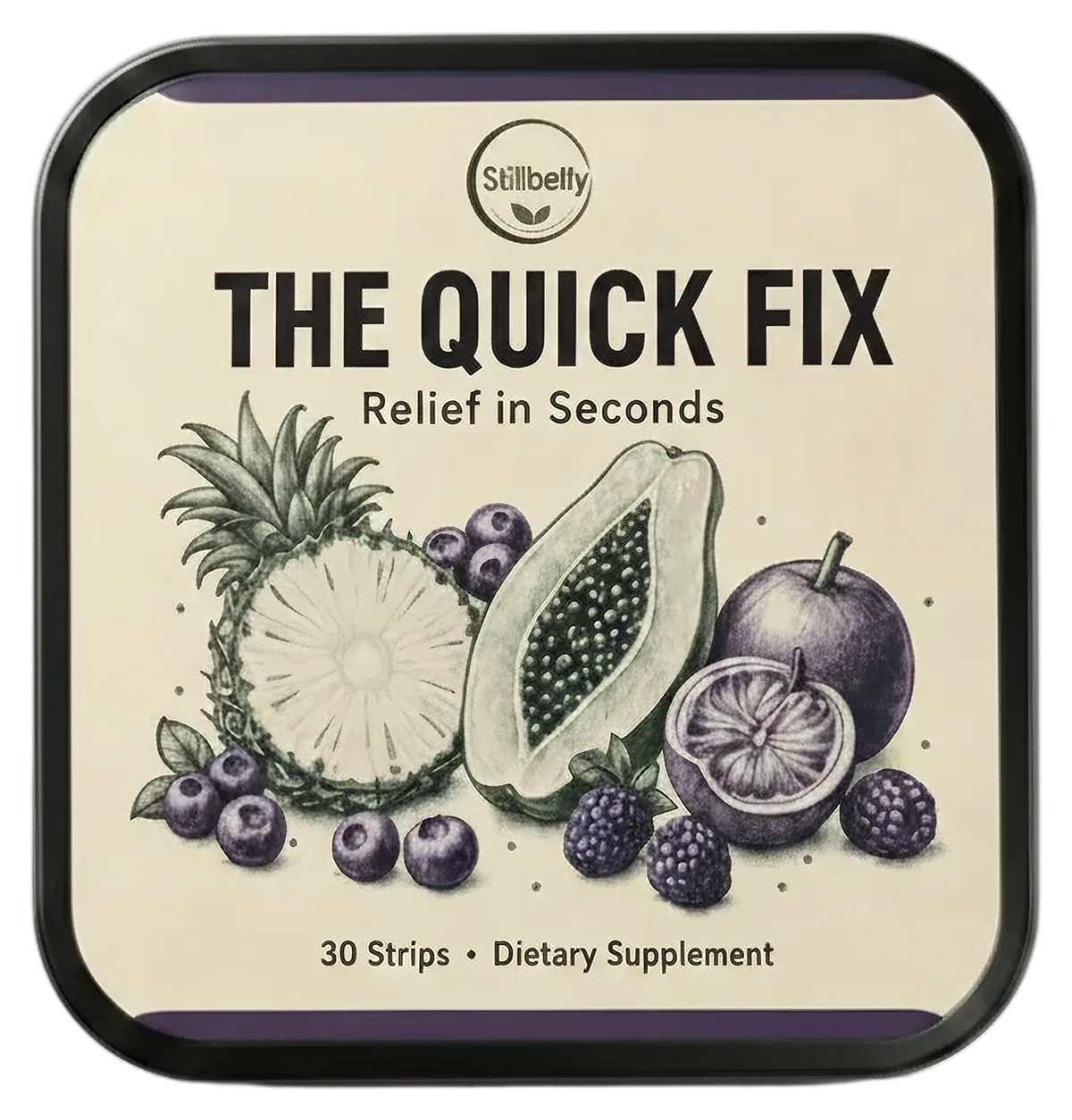
It is also why The Quick Fix is a strip. It dissolves on your tongue and starts working in seconds, instead of waiting to survive your stomach like a capsule has to.
The bottom line
Most everyday bloat is gas from food fermenting before it is fully digested. Eat slower, notice your triggers, help the meal break down, and see a doctor if it is persistent or painful.
From this article
The Quick Fix
Enzyme strips that start working in seconds.
Shop →Frequently asked questions
Why am I so bloated after eating?
Usually because food is fermenting in your colon before it is fully digested, producing gas that stretches the gut wall. Eating quickly, large meals, and certain carbs all make it worse.
How do I get rid of bloating fast?
Slow down, take a short walk, avoid carbonated drinks, and consider a fast-acting digestive enzyme with the meal. Persistent bloat needs a doctor, not a quick fix.
Do digestive enzymes help with bloating?
They can. By breaking more of your meal down before it reaches the fermenting bacteria in your colon, enzymes leave less material to produce gas.
Is it normal to bloat every day?
Occasional bloating is normal, but daily or painful bloating is worth discussing with a healthcare provider to rule out underlying conditions.
Peer-reviewed & published in




Intestinal gas is produced by microbial fermentation of undigested carbohydrate
Mutuyemungu E et al.
Read the 2023 studyFermentable carbohydrates (FODMAPs) drive gas and bloating symptoms
Halmos EP et al.
Read the 2014 studyReview of the mechanisms behind bloating and abdominal distension
Seo AY, Kim N, Oh DH
Read the 2013 studySources are peer-reviewed research on the topics discussed, not studies of finished Stillbelly products. These statements have not been evaluated by the FDA.
Educational content, not medical advice. These statements have not been evaluated by the FDA. Talk to your healthcare provider about persistent digestive symptoms.