
Apple cider vinegar, minus the wince
What does apple cider vinegar actually help with, and is drinking it worth the wince? ACV has real research behind it, but the way most people take it is rough on their teeth and throat. Here is what the science looks at, and how to get the benefits without the burn.
Grounded in 4 peer-reviewed studiesThe quick version
Key takeaways
- The active part of ACV is acetic acid, studied mostly around meals.
- Research centers on post-meal blood sugar and fullness, not miracle claims.
- Drinking vinegar risks tooth enamel; capsules keep the acid off your teeth.
- Look for a stated ACV dose, and take it before your biggest meal.
01What is apple cider vinegar, really?
Apple cider vinegar starts as apple juice. Yeast turns the sugar into alcohol, then bacteria called acetobacter turn the alcohol into acetic acid. That acetic acid is the sour, functional heart of vinegar, and it is what nearly every ACV study is actually about.
So when people talk about the benefits of ACV, they are mostly talking about a single compound, at a modest dose, taken around meals.
02What does apple cider vinegar help with?
The honest answer is narrower than the internet suggests, but it is real. Small human studies have looked at vinegar taken with high-carbohydrate meals and at daily vinegar intake over several weeks. The areas researchers have studied most:
- Post-meal blood sugar response when taken with a carb-heavy meal 1
- Feelings of fullness after eating
- Daily vinegar intake studied over multi-week periods for body weight and fat 2
- We link the actual papers rather than paraphrasing them into promises.
1000mg
ACV powder per serving
in the range studies used
~5%
acetic acid, the active part
the functional heart of vinegar
0
acid on your teeth in a capsule
none of the enamel exposure
Figures reflect The Spark's formulation and the general chemistry of vinegar. See our science page for the human studies.
03The problem with just drinking it
Vinegar is acid. It tastes like a punishment, and dentists have firm opinions about what regular swigs do to tooth enamel. Plenty of people's stomachs object too. Diluting it helps the teeth a little and the flavor not at all.
That trade-off, real benefit versus a genuinely unpleasant delivery, is the whole reason capsules exist.
04Why capsules, and how much
A capsule keeps the acetic acid and skips the acid bath on your teeth and throat. The thing to watch is dose and honesty: look for a product that states the actual ACV amount per serving instead of burying it in a proprietary blend.
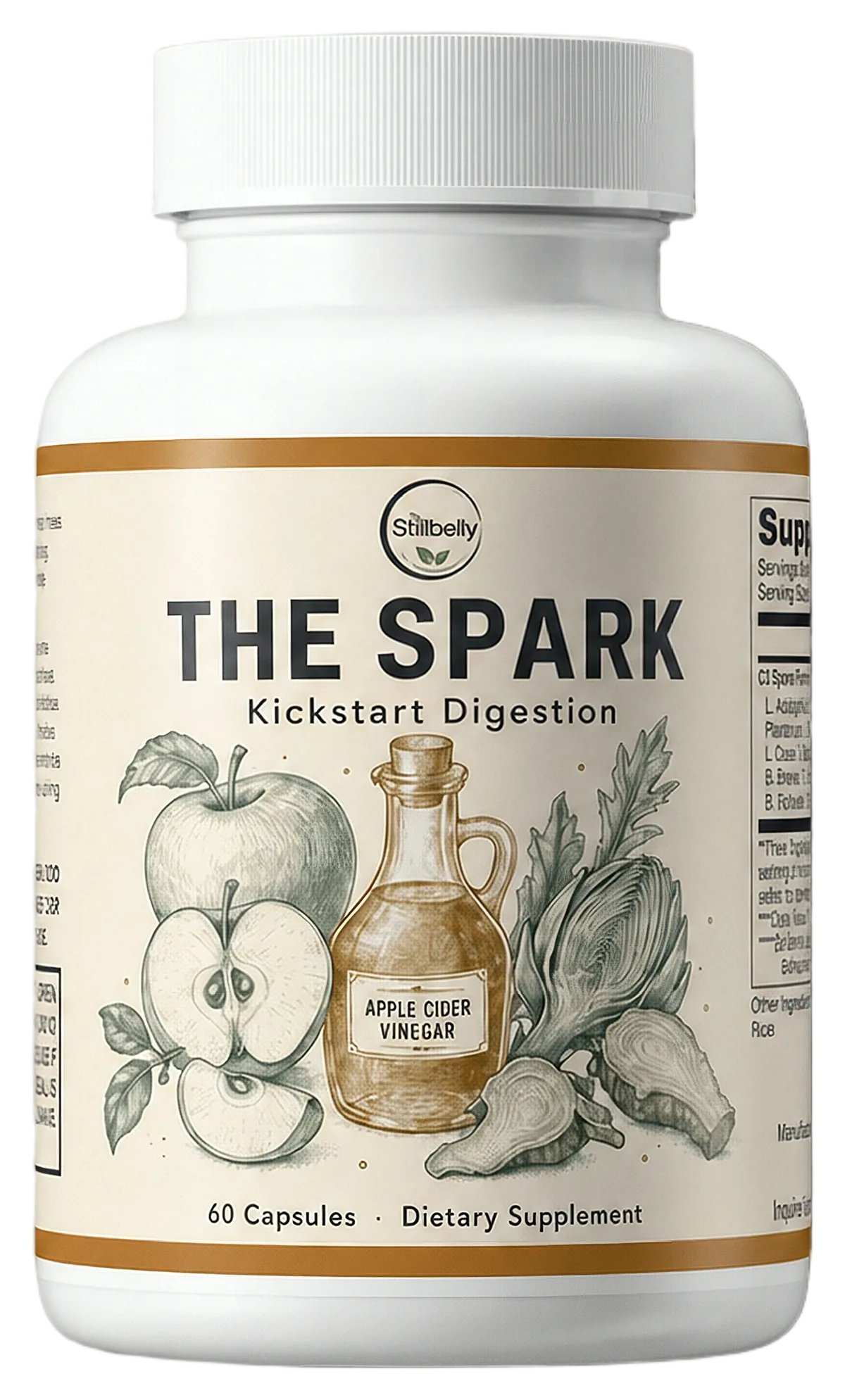
The Spark delivers 1000mg of ACV powder per serving, in the range studies actually used, and pairs it with prebiotic inulin and a live probiotic because they work on adjacent problems, not because the label needed to look longer.
05How and when to take it
- Take it around mealtimes, especially before a carb-heavy meal, which is when the research suggests it does its work.
- Prefer a stated dose over a mystery blend.
- Consistency beats intensity. A daily habit matters more than a big occasional dose.
06Does apple cider vinegar help with bloating?
Honestly, the evidence here is thin. No good human trial has tested apple cider vinegar specifically for bloating, so anyone promising it as a bloat cure is going past what the research actually shows.
What we do have is indirect. Vinegar can slow how quickly your stomach empties 4, and it changes the post-meal blood sugar and fullness response when taken with a carb-heavy meal 13. Slower stomach emptying cuts both ways. It can blunt a blood sugar spike, but a fuller, slower-emptying stomach can also feel more bloated for some people, not less.
So the candid read is this: apple cider vinegar is not a proven bloating remedy, and for a subset of people it may add to that heavy, full feeling rather than ease it. If bloating is your main complaint, the boring levers with better support, slowing down, chewing, and noticing which foods repeat on you, are a smarter first move.
07Does it help with gas, constipation, indigestion, and digestion?
Short version: there is little to no direct human research on apple cider vinegar for gas, constipation, or indigestion. The popular idea that vinegar broadly boosts digestion rests mostly on the theory that a little extra acid helps break food down, and that theory has not been demonstrated in controlled trials for these symptoms.
It is worth separating the pieces. The studied effects of vinegar are on post-meal blood sugar and fullness 13, not on gas volume, stool frequency, or heartburn. If you genuinely have low stomach acid, that is something a doctor can look into rather than something to self-treat with vinegar.
One honest caution: for indigestion and reflux, adding acid can make symptoms worse for some people, not better. We cover who should be careful further down.
08How long does it take to work?
For the effects that are actually studied, post-meal blood sugar and fullness, vinegar acts within that single meal, generally in the window around 30 to 60 minutes after eating 13. It is a with-the-meal effect, not an overnight one.
For anything longer term, the honest timeline is much fuzzier. The one multi-week trial on body weight had people take vinegar daily for 12 weeks 2, and the changes were modest. There is no evidence of a rapid detox or a flat-stomach-by-morning effect, and for bloating specifically there is no established timeline at all, because it has not been shown to reliably work.
09Capsules vs liquid vs gummies: does the form matter?
What matters most is getting a real, stated dose of acetic acid in the range studies used, without eroding your teeth. That framing sorts the formats quickly.
Liquid delivers acetic acid but is acidic enough to wear down tooth enamel and irritate the throat with regular use. Capsules keep the dose and skip the acid bath. Gummies are the weakest option for this purpose: many contain only a small amount of actual ACV, add sugar, and their acidity can still reach your teeth.
The honest caveat is that no head-to-head trial proves a capsule matches liquid gram for gram. The case for capsules is practical: a clearly stated dose and no enamel exposure. That is exactly how The Spark is built, 1000mg of ACV powder per serving, stated on the label rather than buried in a blend.
10When should you take apple cider vinegar?
- Take it with or just before a carbohydrate-heavy meal, which is when the research that shows an effect was done 13.
- Around your biggest meal of the day is the sensible default.
- Taking it on a completely empty stomach has no proven added benefit and can be harder on your stomach and throat.
- Consistency beats intensity. A small daily habit fits the research better than an occasional large dose.
11Who shouldn't take apple cider vinegar?
Vinegar is not right for everyone, and this is general information rather than medical advice. If any of the following apply to you, talk with your doctor before making it a habit:
- Your teeth: regular acid exposure can erode enamel. A capsule and rinsing with water afterward both reduce that contact.
- Low potassium, or medications that can lower it such as some diuretics: very large, long-term vinegar intake has been linked to low potassium in isolated case reports, so caution is sensible.
- Blood-sugar medications like insulin or sulfonylureas: because vinegar can affect post-meal blood sugar, combining the two is something to clear with your doctor first.
- Acid reflux or indigestion for some people: added acid can aggravate symptoms rather than settle them.
- Delayed stomach emptying: vinegar can slow how fast the stomach empties 4, which may worsen symptoms if that is already an issue for you.
The bottom line
Apple cider vinegar has modest, real research behind it for post-meal blood sugar and fullness. Take a stated dose around your biggest meal, and skip the tooth-eroding shots.
From this article
The Spark
1000mg of ACV per serving, no vinegar taste.
Shop →Frequently asked questions
What does apple cider vinegar actually help with?
Human studies have mainly looked at its effect on post-meal blood sugar response and feelings of fullness when taken with a meal. The evidence is real but narrower than most online claims suggest.
Should I take apple cider vinegar before or after meals?
The research that shows an effect generally used vinegar taken with or just before a carbohydrate-heavy meal, so before your biggest meal is the sensible time.
Does apple cider vinegar help you lose weight?
Some short studies suggest modest effects on fullness and metabolic markers, but ACV is not a weight-loss shortcut. It works best as a small, consistent habit alongside diet and movement.
Are ACV capsules as good as liquid?
Capsules deliver the same ACV powder without the acid exposure to your teeth and throat. Look for one that states the actual milligrams per serving.
Does apple cider vinegar help with bloating?
There is no quality human study showing it relieves bloating. Vinegar can slow stomach emptying and change post-meal fullness, which may help some people feel better and may make others feel more full, so it is not a reliable bloating remedy.
Does apple cider vinegar help with gas or constipation?
There is little to no direct human research on ACV for gas or constipation. The idea that it broadly improves digestion has not been shown in controlled trials for those symptoms.
How long does apple cider vinegar take to work?
For its studied effects on post-meal blood sugar and fullness, vinegar acts within the meal, roughly 30 to 60 minutes after eating. The one multi-week weight study ran daily for 12 weeks, with modest results. There is no evidence of an overnight effect.
Are ACV gummies as effective as capsules or liquid?
Gummies often contain only a small amount of actual ACV and add sugar, and their acidity can still reach your teeth. Look for a form that states real milligrams per serving; capsules deliver a stated dose without the enamel exposure of liquid.
Who should not take apple cider vinegar?
Be cautious if you have enamel concerns, low potassium or take diuretics, take insulin or other blood-sugar medication, have reflux that acid worsens, or have delayed stomach emptying. This is general information, not medical advice, so check with your doctor.
Peer-reviewed & published in




Vinegar improved insulin sensitivity to a high-carbohydrate meal
Johnston CS et al.
Read the 2004 studyDaily vinegar intake reduced body weight and fat over 12 weeks
Kondo T et al.
Read the 2009 studyVinegar with a bread meal increased satiety and lowered post-meal glucose and insulin
Ostman E et al.
Read the 2005 studyApple cider vinegar slowed gastric emptying in patients with type 1 diabetes
Hlebowicz J et al.
Read the 2007 studySources are peer-reviewed research on the topics discussed, not studies of finished Stillbelly products. These statements have not been evaluated by the FDA.
Educational content, not medical advice. These statements have not been evaluated by the FDA. Talk to your healthcare provider about persistent digestive symptoms.